

Banda Aceh News | BANDA ACEH — In a profound effort to rectify historical oversights and honor forgotten figures of the archipelago, the Indonesian Historian Society (MSI) of Aceh Province is convening a high-profile national seminar dedicated to Teungku Fakinah—an extraordinary female cleric, educator, and military commander who fought valiantly during the Aceh War yet remains largely unrecognized in mainstream national history.
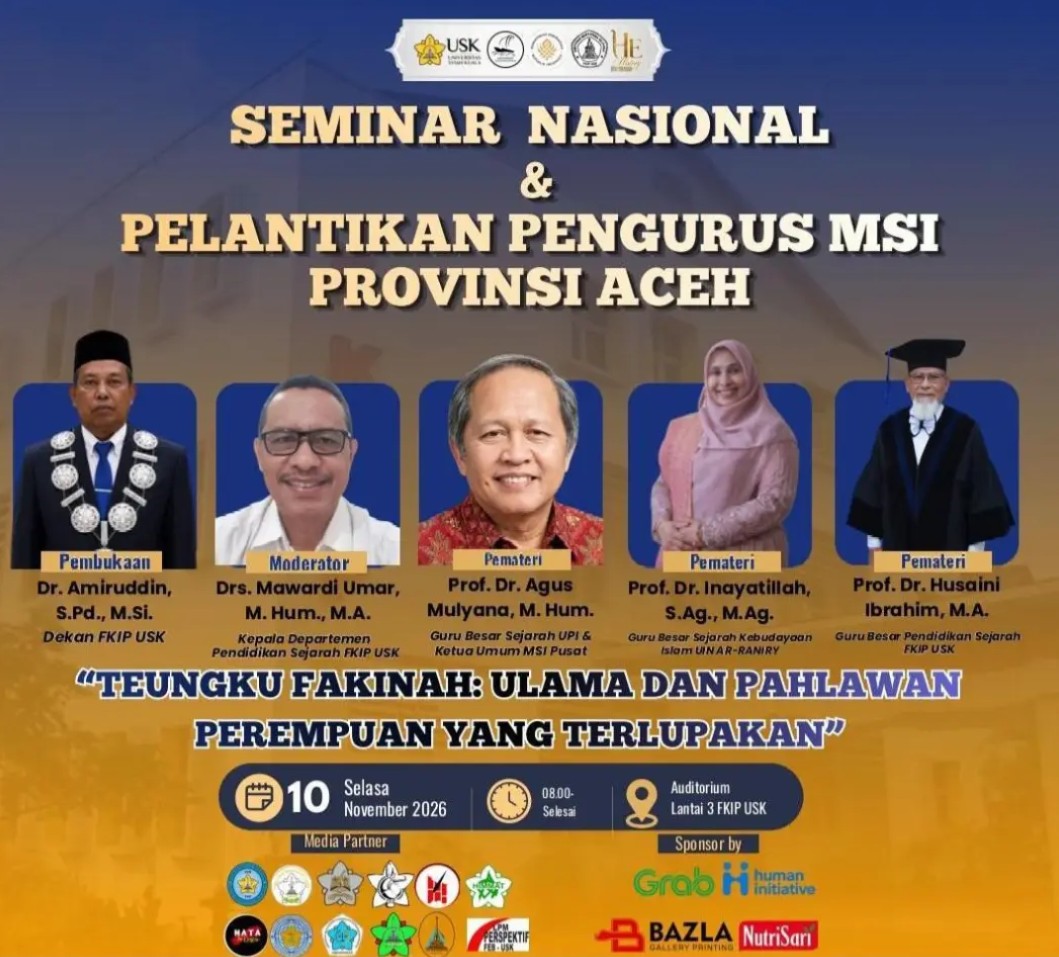
Entitled “Teungku Fakinah: The Forgotten Female Cleric and Heroine,” the academic forum is scheduled for Tuesday, November 10, 2026, at the Level III Auditorium in the Faculty of Teacher Training and Education (FKIP) building at Universitas Syiah Kuala (USK), Banda Aceh.
“This activity aims to enhance the historical literacy of the Acehnese public, particularly concerning local history and the monumental role of women in the nation’s struggle,” stated Committee Chairman Teuku Bahagia Kesuma on Monday, November 9, 2026.
Born around 1856 in Lam Diran, Gampong Lam Krak, Sibreh, Aceh Besar, Teungku Fakinah originated from a respected lineage of religious scholars and matured within the traditional dayah (Islamic boarding school) educational ecosystem. Possessing exceptional scholarly aptitude from a young age, she was entrusted with teaching and managing an educational institution.
When Dutch colonial forces launched brutal military aggressions across Aceh and systematically targeted regional dayahs for destruction, Teungku Fakinah made the historic transition from educator to armed resistance leader. Stepping onto the battlefield, she commanded four distinct military battalions known collectively as the Sukey Fakinah.
Unraveling Historiographical Bias and Regional Erasure
MSI Aceh emphasized that Teungku Fakinah’s remarkable life trajectory represents a seamless fusion of religious scholarship, pedagogical dedication, and fearless military leadership. Nevertheless, her profound contributions have failed to secure a proportional space within Indonesia’s centralized national historical narratives.
The upcoming seminar will critically examine deep-seated historiographical challenges, including gender bias in historical recording, the limitations of archival sources, the pitfalls of Jakarta-centric national history writing, and the severe lack of digital dissemination surrounding local female heroines.
“We want to introduce Teungku Fakinah more completely to the public. She is not only recognized as a female warrior, but also as a cleric and educator who made an immense contribution to Aceh’s history,” Teuku Bahagia asserted.
Through this national dialogue, organizers hope to stimulate advanced academic research, inspiring university student theses and popular literature alike. By opening new pathways for digital documentation and public history projects, MSI Aceh aims to ensure that regional heroines who shaped the Sumatran frontier are properly preserved for younger generations.
Paving the Way Toward National Hero Status
While Aceh is historically celebrated for iconic National Heroines designated by the state—such as Cut Nyak Dhien, Cut Nyak Meutia, and Admiral Malahayati—scholars argue that Teungku Fakinah’s legacy warrants identical national reverence.
“Perhaps this National Seminar will serve as the foundational starting point to formally propose Teungku Fakinah as a recognized National Hero,” Teuku Bahagia noted.
The symposium is structured as a dynamic panel discussion involving students, academics, cultural communities, and policy stakeholders. Crucially, the event has invited key institutional bodies capable of advancing the National Hero nomination process, including the Teungku Fakinah Foundation, the Aceh Cultural Preservation Center (BPK), the Aceh Culture and Tourism Office (Disbudpar), and the Aceh Provincial Social Service.
The scholarly panel features an elite lineup of speakers:
- Prof. Dr. Agus Mulyana, M.Hum. (Professor of History at Universitas Pendidikan Indonesia / UPI Bandung and General Chairperson of MSI), addressing gender representation in Indonesian historiography.
- Prof. Dr. Inayatillah, S.Ag., M.Ag. (Professor of Islamic History and Culture at UIN Ar-Raniry Banda Aceh), exploring Teungku Fakinah’s profound religious scholarship.
- Prof. Dr. Husaini, M.A. (Professor of Historical Education at FKIP USK), analyzing her overlooked legacy as a pioneer female freedom fighter.
The seminar—co-organized by the FKIP USK History Student Association (HIMAS) and moderated by MSI Aceh Chairperson Mawardi—will run concurrently with the inauguration of the new MSI Aceh executive board and the opening of History Expo VIII.
Reclaiming the Margins of History
As academic institutions increasingly interrogate the silences of the past, forums like the Teungku Fakinah seminar do more than unearth dusty archival fragments; they actively recalibrate national memory. For decades, official state narratives have streamlined the complex tapestry of anti-colonial resistance into a handful of metropolitan-approved figures.
By elevating figures like Teungku Fakinah—who balanced intellectual rigor in the study hall with fierce tactical command on the battlefield—Acehnese historians are rewriting the perimeter of Indonesian heroism. This intellectual movement challenges regional erasure and proves that the architecture of Indonesian independence was forged by countless unheralded local leaders whose enduring courage continues to shape the soul of the nation.