

Banda Aceh News | JANTHO, ACEH — Traditional Acehnese musical instruments can now be played in an immersive, interactive digital environment following a groundbreaking innovation developed by lecturers at the Indonesian Institute of Arts and Culture (ISBI) Aceh. Financed through the Fundamental Regular Research (PFR) grant scheme by the Directorate of Research and Community Service (DPPM) under the Ministry of Higher Education, Science, and Technology for Fiscal Year 2026, the project bridges centuries-old heritage with cutting-edge technology.
Titled “Transforming Traditional Acehnese Musical Instruments into Interactive Media Based on Virtual Reality Technology for Immersive Learning,” the initiative seeks to revolutionize arts education while safeguarding Sumatran cultural identity in an increasingly digital era.
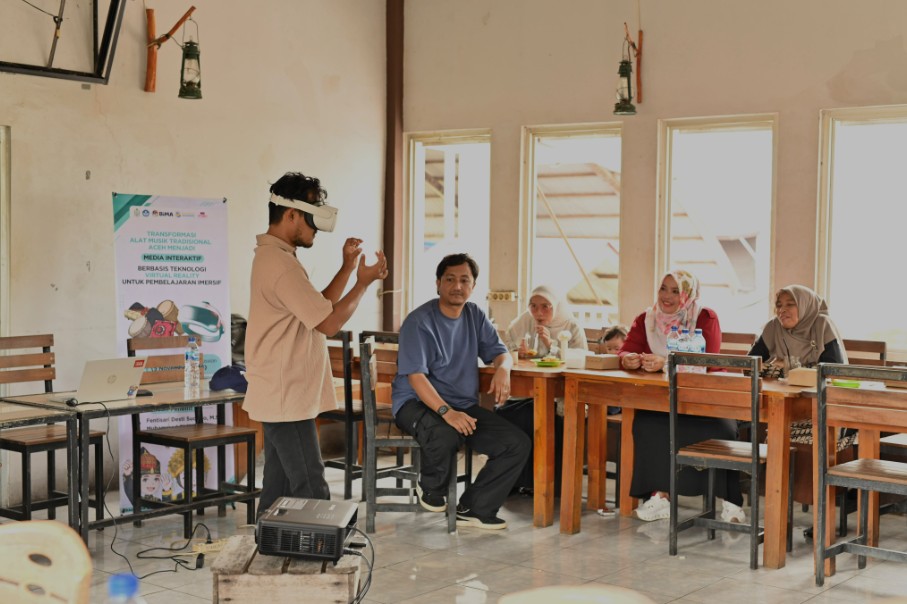
The innovation was presented and tested during a Focus Group Discussion (FGD) on Thursday, November 5, 2026, creating a collaborative platform to refine software mechanics while ensuring the VR simulations remain deeply rooted in authentic regional traditions.
Led by lead researcher Fentisari Desti Sucipto, M.Sn., alongside co-researchers Muhammad Ghifari, M.Sn., and Abdul Rozak, M.Sn., the team engineered a custom VR environment where students can physically interact with, inspect, and play virtual renderings of traditional instruments.
Unlike conventional instructional methods that rely on static imagery or passive audio demonstrations, Virtual Reality delivers fully immersive sensory feedback. Students navigate a 3D environment to learn accurate playing techniques, physical sound mechanics, and historical contexts of indigenous instruments.
Multi-Stakeholder Testing and Two-Year Development Cycle
The FGD brought together a broad spectrum of cultural and academic figures, including representatives from the Aceh Arts Council (DKA), the Aceh Besar Youth and Sports Office, arts educators from SMAN 1 Jantho and MAN 3 Aceh Besar, traditional musicians, visual design experts, and senior cultural scholars.
This cross-sector consultation ensures that the software moves beyond mere visual gimmickry to deliver precise historical accuracy, high educational value, and cultural authenticity.
“This research represents a rigorous two-year development cycle, beginning with comprehensive mapping of traditional Acehnese musical instruments and culminating in a fully functional VR learning module. We are launching field trials across selected schools in Aceh Besar and Banda Aceh,” explained lead researcher Fentisari Desti Sucipto.
Fentisari acknowledged that the application remains open to technical refinements, emphasizing that ongoing interdisciplinary collaboration will be key to expanding its operational scope.
Empowering Youth Through Digital Heritage Safeguarding
The initiative earned strong backing from the Aceh Arts Council. DKA representative Dr. Rasyidin, M.Sn., praised the project as a vital technological intervention to reconnect younger generations with their roots.
“Research of this nature is exceptionally valuable, particularly given the scarcity of modern digital tools that remind our youth of their underlying Acehnese cultural heritage,” Dr. Rasyidin noted.
The project also served as an experiential learning incubator for ISBI Aceh university students, who actively produced 3D visual assets, managed technical VR programming, and organized media outreach. Student contributors included Ananda Audlia Pranata, Galuh Caturangga, Marliana, Qanitah Binti Suwardi, Muthi’ah Hanina, Rahil Lutfiya Firdaus, Muhammad Aulia Akbar, and Murni Ananda.
By marrying artistic tradition with digital simulation, ISBI Aceh is demonstrating that cultural preservation does not require static adherence to conventional methods. By embracing new digital frontiers, ancient musical traditions can thrive in interactive spaces without forfeiting their foundational identity.