

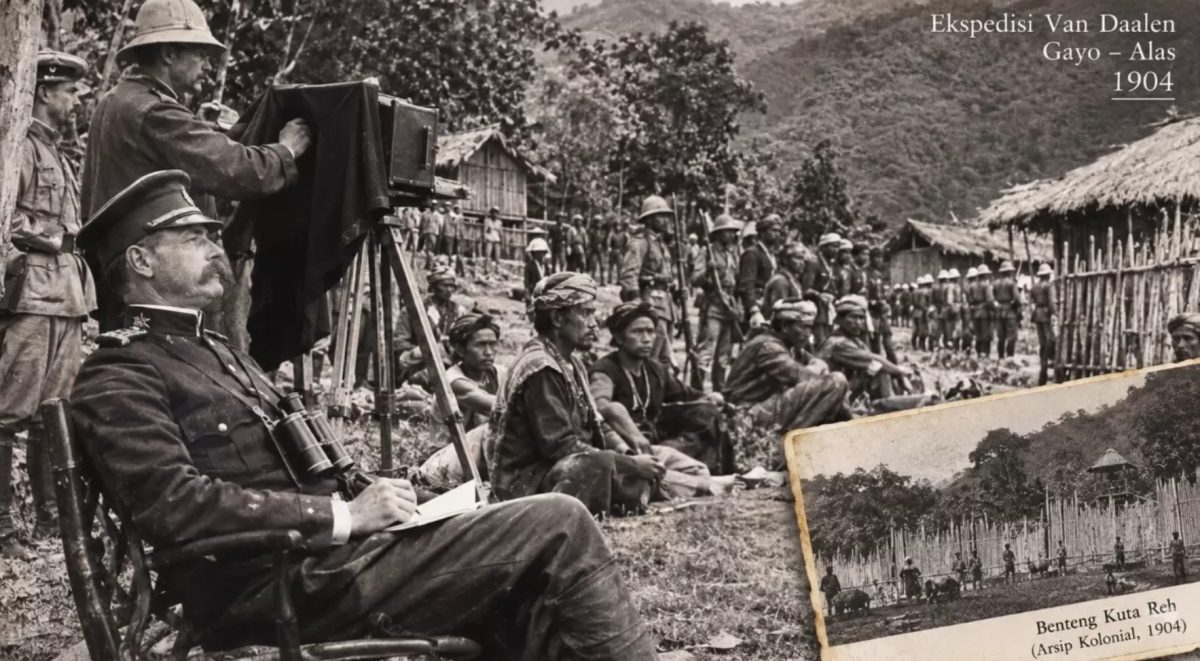
Banda Aceh News | BANDA ACEH — The surviving photographic archives of the 1904 Dutch military campaign into the Gayo and Alas highlands represent far more than routine colonial expedition records. Beyond the stark visual documentation of fortified encampments, indigenous villages, uniformed columns, and local populations lies chilling photographic evidence of an aggressive pacification strategy that resulted in one of the most tragic human casualties of the Aceh War.
Among the primary historical references documenting this campaign is the seminal work “De tocht van Overste van Daalen door de Gajo-, Alas- en Bataklanden” authored by J.C.J. Kempees and published around 1905. Archival records from the Rijksmuseum confirm that this 265-page volume contains 29 original photographic plates alongside five detailed tactical maps, chronicling the military expedition that raged across northern Sumatra between February 8 and July 23, 1904.
However, modern historiography emphasizes that Kempees—who served as an officer during the campaign—was not the sole figure responsible for capturing these historical visuals. Crucial nuanced distinctions must be drawn between the official report author, the commanding officer Lieutenant Colonel Gotfried Coenraad Ernst van Daalen, and the actual individuals operating behind the camera lens.
Unmasking the Photographer: H.M. Neeb and Colonial Violence
Groundbreaking research by historian Paul Bijl, published in his critical study “Imperial Frames, 1904,” identified H.M. Neeb, an army medical officer attached to the expeditionary force, as the primary photographer responsible for taking many of the most devastating images of combat casualties and destroyed fortified settlements (kuta).
Neeb’s dual role as a medical practitioner and field photographer provided him with unfiltered access to the immediate aftermath of military assaults across the Gayo and Alas valleys. His photographs meticulously recorded dead defenders—including women and children trapped within fortified village perimeters—providing incontrovertible visual evidence of the extreme force deployed by the Royal Netherlands East Indies Army (KNIL).
Bijl’s academic investigation further traced the public circulation and institutional afterlife of these sensitive visual artifacts. Between February 5 and February 12, 1905, a curated selection of Neeb’s photographs was publicly exhibited in Batavia (now Jakarta). The image glass plates were subsequently reproduced and distributed to elite Dutch institutions, including scientific societies, military academies, and colonial museum archives across Europe.
Photographic Evidence in the Public Sphere
Intriguingly, despite the graphic brutality depicted in several images, a portion of these photographs was explicitly integrated into Kempees’s official 1905 publication. Rather than remaining classified military intelligence, the visual imagery was initially utilized by colonial authorities to demonstrate decisive military pacification and imperial control over previously unyielding highland territories.
Over the decades, however, the contextual interpretation of these archival frames underwent a dramatic reversal. What was once framed as a triumphant military campaign is now recognized by international historians and local heritage advocates as an undeniable visual record of colonial atrocities and destruction inflicted upon the indigenous communities of North Sumatra.
Today, the preservation and re-examination of Neeb’s photographic legacy continue to serve as a vital catalyst for historical justice, scholarly research, and collective memory regarding the tragic human cost of the 1904 Gayo-Alas campaign.