

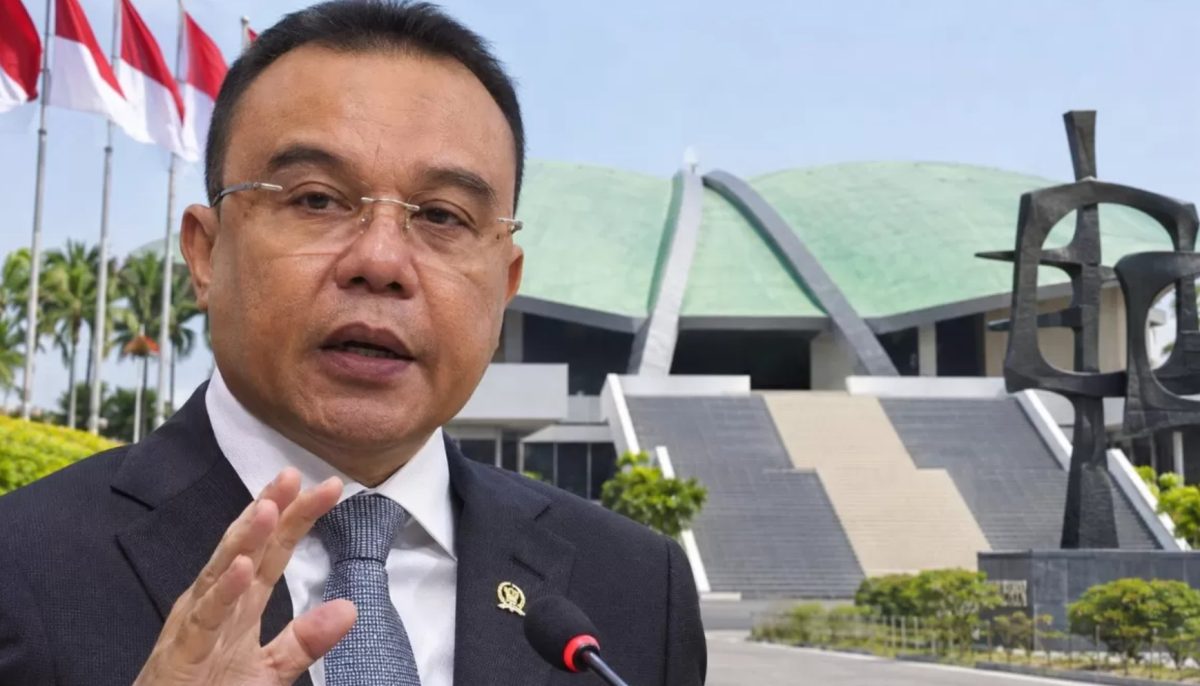
Banda Aceh News | JAKARTA — National political dynamics reached a critical juncture on Monday, November 9, 2026, after House of Representatives (DPR) Deputy Speaker Sufmi Dasco Ahmad announced that parliamentary leadership is prepared to receive formal aspirations from civil society organizations and cross-faction lawmakers regarding the constitutional standing of Vice President Gibran Rakabuming Raka.
Dasco’s statement arrived amid mounting public controversy following a Supreme Court (MA) decision that granted a legal challenge revoking the high school equivalency certificate utilized by Gibran during his 2024 vice-presidential candidacy. The ruling has intensified debates among constitutional experts and political factions concerning the legal validity of the election outcome and the Vice President’s ongoing tenure.
Addressing reporters at the parliamentary complex in Senayan, Dasco emphasized that the legislative body has not yet formulated an official institutional stance. With the DPR returning to active session on Tuesday, November 10, 2026, the leadership has yet to convene a Speakers’ Meeting or assemble the Deliberative Body (Bamus) to consult cross-faction leadership, as the legislature awaits the complete certified copy of the Supreme Court ruling.
Nevertheless, political analysts note that Dasco’s remarks mark a decisive transition: legal and administrative disputes surrounding the Vice President have moved from public discourse into the formal legislative arena, where informal discussions regarding right of inquiry (hak angket) mechanisms and impeachment protocols have begun circulating across party lines.
Constitutional Framework and Impeachment Thresholds
The controversy surrounding the Vice President extends far beyond procedural education administration, raising foundational questions regarding constitutional candidacy requirements and the downstream effects of judicial rulings on executive mandates. However, legal scholars caution that the invalidation of an administrative document does not automatically trigger an immediate forfeiture of executive office.
Under Articles 7A and 7B of the 1945 Constitution of Indonesia (UUD 1945), removing a sitting President or Vice President demands a rigorous, multi-stage constitutional process. The DPR must first construct a formal legislative opinion passed by a parliamentary supermajority, submit the case to the Constitutional Court (MK) for judicial trial, and, if validated, bring the matter before the People’s Consultative Assembly (MPR) for a final determination.
Consequently, while Dasco’s open-door policy does not signal the immediate commencement of impeachment proceedings, the institutional alignment of cross-faction lawmakers as parliament resumes will serve as a bellwether for President Prabowo Subianto’s governing coalition.
Illegal Wiretapping Investigation Shakes the Security Establishment
Compounding the political tension in the capital, the administration is simultaneously confronting a high-stakes law enforcement scandal involving allegations of illegal wiretapping and cyber espionage within the highest echelons of the National Police (Polri).
Specialized investigators have indicted four suspects—including high-ranking officers linked to former Police Chief General (Ret.) Listyo Sigit Prabowo—over charges of unauthorized surveillance, electronic data deletion, and illegal access to secure telecommunications networks. The probe centers on the systemic abuse of the Lawful Interception Management System (LIMS).
The scandal has sent shockwaves through political circles following revelations that the unauthorized surveillance targeted state officials, political leaders, civil society activists, media executives, and prominent corporate figures. To address growing public concern, DPR Commission III Chairman Habiburokhman confirmed that National Police Chief General Suyudi Ario Seto has been summoned to appear before parliament on November 12, 2026, to clarify the masterminds, motives, and legal accountability behind the operation.
The parliamentary summons follows an unannounced meeting hosted by President Prabowo Subianto at his Hambalang residence on November 8, where he met with ten former National Police chiefs. The convergence of these developments highlights deepening structural realignments within Indonesia’s security apparatus following the executive transition from former President Joko Widodo to Prabowo.
Market Sentiments and Economic Vulnerabilities
The dual political and law enforcement challenges unfold against a delicate economic backdrop. At the close of trading on Monday, November 9, the Indonesia Stock Exchange (IHSG) rose 0.46 percent to 5,073.77 with a transaction volume of Rp9.1 trillion, demonstrating resilience in equity markets.
However, the Indonesian Rupiah remains under pressure, trading near Rp18,000 per US Dollar. Foreign investors and market analysts are monitoring institutional stability closely, as prolonged political friction or inter-agency conflicts risk driving up foreign currency debt servicing costs, import expenditures, and national risk premiums.
As parliament reconvenes on November 10 and Commission III prepares for its high-profile hearing on November 12, the Prabowo administration faces an unprecedented triple stress-test: maintaining constitutional legitimacy, ensuring transparent police accountability, and reassuring international financial markets of Indonesia’s long-term institutional stability.