

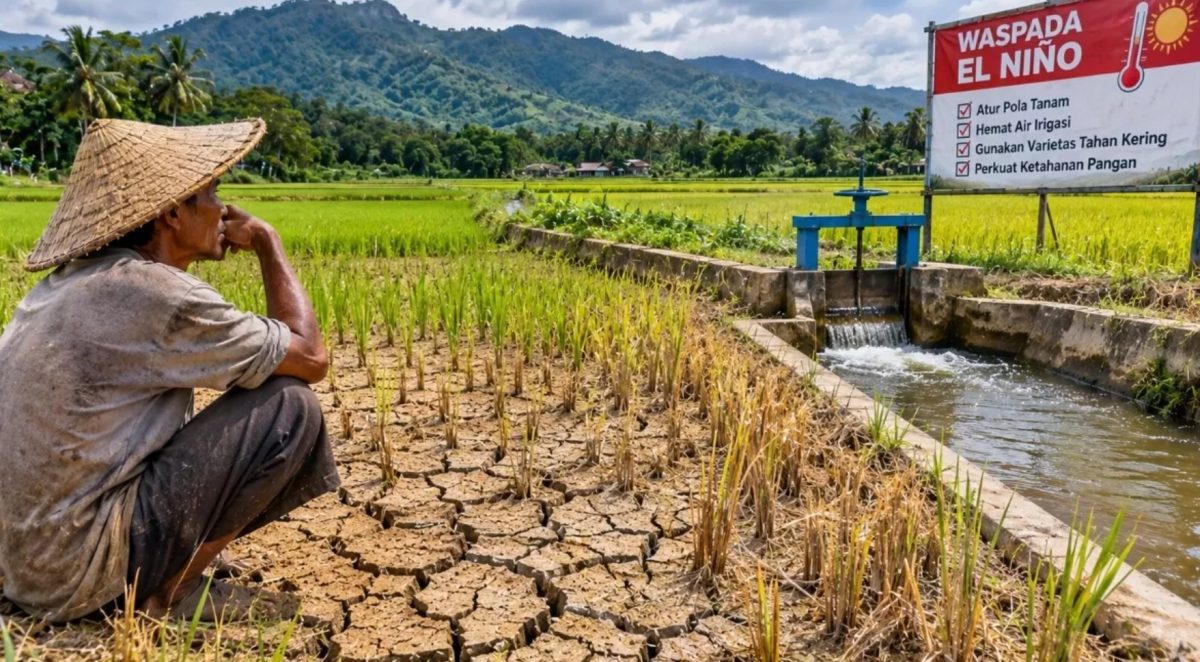
Banda Aceh News | BANDA ACEH — The cascading threat of extreme weather patterns in Indonesia’s northernmost province extends far beyond immediate meteorological crises such as prolonged dry spells, localized forest fires, or depleted river discharges. At its core, the intersection of climate volatility and agricultural decline poses a structural challenge to regional food security, farmer livelihoods, and the local government’s capacity to guarantee stable staple supplies.
Recent statistical indicators published by the Central Statistics Agency (BPS) of Aceh underscore a troubling downward trajectory in domestic paddy output. Throughout 2025, harvested agricultural land spanned approximately 283,180 hectares, yielding roughly 1.62 million tons of dry unhusked rice (GKG)—a notable decline from 1.66 million tons recorded in the previous year.
Projections for 2026 point toward intensifying structural pressures. According to BPS estimates released on November 3, 2026, the harvested area is forecasted to contract to 265,930 hectares, representing a reduction of 17,250 hectares, or a 6.09 percent drop compared to the preceding year. Concurrently, regional rice production is projected to plummet by roughly 60,700 tons, or 6.52 percent.
Nevertheless, agricultural analysts caution that raw statistical declines cannot be prematurely attributed solely to El Niño phenomena. Confounding variables—including prior flood disruptions, shifting planting calendars, degraded irrigation infrastructure, localized pest infestations, and broader rural economic pressures—demand rigorous empirical scrutiny.
However, consecutive drops in agricultural yield amid escalating climate uncertainty serve as an urgent warning sign for regional policymakers.
Paddy Fields at the Mercy of Political Decisions
The hydrological networks feeding Aceh’s vast agricultural heartlands rely on delicate, interconnected ecosystems spanning highland forests, critical water catchments, river basins, and engineered irrigation canals. When upstream land covers are compromised by deforestation or conversion, soil erosion and sedimentation rates escalate dramatically.
Under specific environmental thresholds, the capacity of regional water catchments to sustain steady river flows during prolonged dry seasons becomes severely impaired. Consequently, administrative decisions governing mining concessions, commercial plantations, infrastructure development, and forest protection zones bear a direct, causal relationship with agricultural resilience.
The core policy dilemma extends beyond whether corporate or land-use permits comply with administrative formalities; rather, it questions whether the cumulative downstream impacts on agricultural water supplies are adequately accounted for.
In October 2026, the Aceh Provincial Government convened a high-level strategic coordination meeting focusing on 2027 food crop targets, drawing together representatives from agricultural agencies, water management authorities, BPS, and the Meteorology, Climatology, and Geophysical Agency (BMKG).
Discussions centered on adaptive cropping patterns designed to withstand climate anomalies. While cross-institutional coordination remains vital, regional observers emphasize that its ultimate efficacy must be measured on the ground: functional irrigation channels, timely seasonal data dissemination for smallholder farmers, and reliable water retention systems during dry spells.
Historical Lessons and the Politics of Water Access
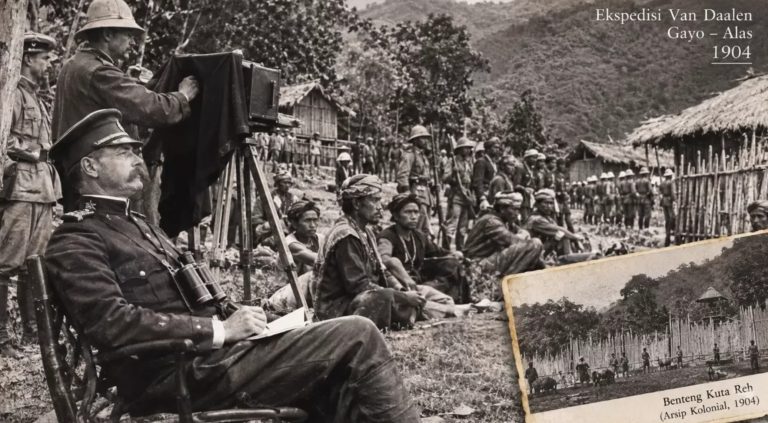
Historical precedent across Aceh demonstrates that food crises are rarely restricted to production deficits alone. During the Japanese colonial occupation, aggressive forced rice requisitioning and the mobilization of corvée labor for military objectives severely crippled local access to nourishment.
This historical trajectory serves as a stark reminder that political decisions can exponentially magnify vulnerabilities initially triggered by environmental shocks. As contemporary Aceh grapples with modern climate pressures, fundamental questions persist regarding institutional governance: who controls primary water resources, who dictates their allocation, and who bears the economic cost when agricultural yields collapse?
While El Niño remains an exogenous natural phenomenon, a society’s capacity to mitigate its devastation is fundamentally determined by the quality, transparency, and foresight of public policy. Safeguarding Aceh’s agrarian future requires far more than superficial production targets; it demands robust forest conservation, rigorous watershed management, functioning irrigation networks, and sustainable land-use legislation designed to protect future generations.
Note: Current 2026 agricultural figures remain preliminary projections rather than finalized year-end realizations. Definitive attribution of yield reductions to El Niño requires comprehensive cross-referencing of rainfall volumes, localized crop damage assessments, and regional irrigation functionality across individual regencies, even as BMKG forecasts continued heavy rainfall potentials for parts of Aceh through November 2026.